Surah an-Nahl, 79
Aerodynamic Forces and the Flight Programmed in Birds
Due to the force of gravity, all bodies which are airborne should eventually fall to earth, either quickly or slowly. Everything, living or otherwise, is subject to the Earth’s gravitational pull.
أَلَمْ يَرَوْا۟ إِلَى ٱلطَّيْرِ مُسَخَّرَٰتٍۢ فِى جَوِّ ٱلسَّمَآءِ مَا يُمْسِكُهُنَّ إِلَّا ٱللَّهُ ۗ إِنَّ فِى ذَٰلِكَ لَءَايَٰتٍۢ لِّقَوْمٍۢ يُؤْمِنُونَ ٧٩
Do they not see the birds suspended in mid-air up in the sky? Nothing holds them there except Allah. There are certainly signs in that for people who believe.
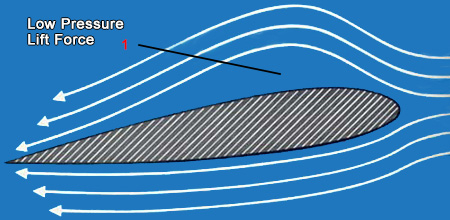
Due to the force of gravity, all bodies which are airborne should eventually fall to earth, either quickly or slowly. Everything, living or otherwise, is subject to the Earth’s gravitational pull. But as a miracle of Allah, birds are able to resist this force and fly upward and downward in the air with extraordinary ease and agility. They maneuver in the air, and sometimes even fold their wings and glide through it with effortless grace and dignity. Even the minutest details which scientists have discovered in the bodies of birds - from their beautiful feathers to their powerful lungs, from the arrangement of the general physiology to the shape of their perfect wings - are equipped with special features and a faultless order which enables them to fly. A chick totally unaware of the act of flight and the laws of aerodynamics is born with the ability to fly. The chick launches itself downwards and begins to fly, just as if it knew its body was created for flight. This is not information that is taught subsequently nor is this something that a bird learns by trial and error. Amazingly, a bird knows it has the body structure needed to fly. Without any encouragement, it naturally possesses the courage to launch itself into the air and then flies without hitting the ground. This can only happen through Allah's inspiration.
The Arabic word "yumsikuhunna" translated as "holds" in verse 79 of Surat an-Nahl means "not letting them go, taking them, catching them, or holding them." The word is the present tense of the verb "amsaka," meaning "to catch with the hand, hold and pull back." With this word, our Almighty Lord reveals that He holds the bird in the air and that it flies by His command. Bird flight is still the subject of wide-ranging research by scientists. Having observed the perfection of bird flight, scientists use the avian body and avian flight ability as direct models in producing such vehicle as airplanes and jets.
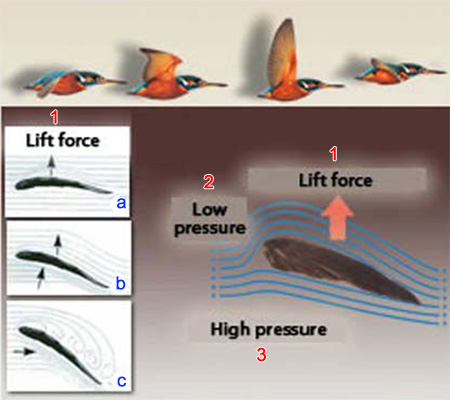
The above-mentioned verse may well be highlighting the manner in which birds comply with the aerodynamic laws created by Allah as they fly. The science of aerodynamics studies the behavior of solid bodies in a fluid environment such as air. For example, as a plane moves through the air, various forces emerge that affect its movement. In order for the plane to move as planned and not to run into any resistance, the plane is thoroughly tested beforehand against the resistance exhibited by the air. Its shape and movement is planned as a result of lengthy calculations, measurements and experiments.
Today, scientists are still astonished at how birds defy gravity with such skill and poise. Using no form of trial and error, they cope with the laws of aerodynamics in the most perfect manner. The use of the word "musakhkharatin" (suspended) in the verse to describe bird flight is an exceedingly specific choice of language, because it suggests that they have been "encouraged to a specific end, have had to do something, have submitted or bowed their heads, have bound themselves to Allah or have submitted to His laws". This is the implication contained in the word itself. In that way, the verse may be indicating the manner in which aerodynamic laws have a determining influence on bird flight. (Allah knows the truth.)
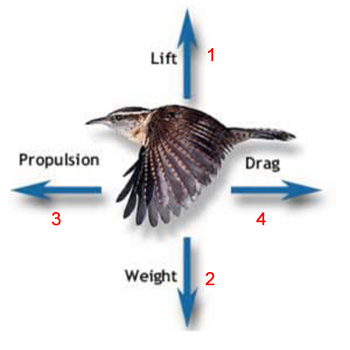
At first sight, there would appear to be nothing to make it difficult for birds to fly. But according to the laws of aerodynamics, any object flying in the air is subject to various different forces. The best-known of these are gravity, propulsion, drag and lift. In order for any meaningful flight to take place, these forces have to be balanced perfectly. The slightest imbalance in a bird would cause it to come crashing down to earth each time it tried to fly. For example, if gravity is stronger than the other forces, the bird will fall to earth. That is why the word in the verse is the best possible expression of the situation which we are examining here. The presence in the Qur'an of expressions containing such information at a time when no science of aerodynamics or mechanics existed, once again, reveals that the Qur'an is a divine text.
In addition to the aerodynamic perfection in bird flight, scientists are also researching the migration patterns of thousands of kilometers that they make. Ornithologists have today concluded that these are literally programmed in them. The way that young birds are able to undertake long and arduous journeys with no guide or previous experience is the most obvious example of this. The Arabic word "musakhkharatin" in the verse quoted above implies "being encouraged toward a specific target, being taken under command, being taken under submission," clearly revealing that birds obey the instructions they are given when following the directions set out for them. There is no possibility of birds, which are devoid of intellect and consciousness, managing to make their own calculations as they fly. Scientists today are in agreement that these extraordinary abilities in birds are "pre-programmed" in them. This is set out in an article in the journal Science:
There is good evidence that young birds are equipped with endogenous migratory programs, which tell them roughly how many days and/or nights that they must fly, and in what direction.1 (emphasis added)
In his book La Puissance et la Fragilité, Pierre Jean Hamburger from René Descartes University describes the extraordinary 24,000-kilometer journey made by the shearwater that lives in the Pacific Ocean:
It sets out from the coast of Australia. From there it flies straight southward to the Pacific. Then it turns north and flies along the coast of Japan until reaching the Bering Sea where it can rest for a while. Following that break it sets off again, and this time heads south. Crossing the western coast of America, it arrives in California. It then crosses the Pacific to return to its starting point. The route and timing of this 15,000-mile (24,000-kilometer) figure '8' journey it makes every year never change.The journey in question lasts a whole six months, always coming to an end in the third week of September on the island it left six months before, at the nest it left six months before. What comes next is even more astonishing; after their return, the birds clean their nests, mate, and lay a single egg over the last 10 days of October. The chicks hatch out two months later, grow very fast and are cared for over three months until their parents set out on that stupendous journey. Two weeks later; around the middle of April, it is time for the young birds to take wing on their own journey. They follow exactly the same route as that described above, with no guide.The explanation is so obvious: These birds must have all the directions for such a journey within the inherited characteristics passed on within the egg.Some people may claim that birds navigate by the Sun and stars or follow the winds prevailing along their route on this journey out and back. But it is clear that these factors cannot determine the journey's geographical and chronological accuracy.2 (emphasis added)
Professor Peter Berthold, a famous ornithologist who has investigated bird migration for 20 years and president of the Max Planck Institute Ornithological Research Center, says the following about bird migration:
Every year an estimated 50 billion birds make migratory journeys, along a network of routes that encompasses the whole world. Sometimes travelling tens of thousands of kilometers, crossing continents and oceans, migratory birds have become so well adapted to this task that they can traverse the largest deserts and seas, the highest mountains and expanses of ice... migratory birds have comprehensive, detailed, innate spatio-temporal programs for successful migration. Such programs evidently enable even young, inexperienced birds to migrate alone, with no adult guide, to the species- or population-specific winter quarters that they have never seen before. As will be explained further below, they do this by "vector" navigation: referring to a vector composed of a genetically predetermined migratory direction and to a time-plan, also genetically predetermined, for the course of migration... It follows that the departure time is programmed by genetic factors... But how do birds "know" the direction in which to migrate, so that they will reach their specific winter quarters? Here, again data have been obtained that point to direct genetic control mechanisms. It has long been suspected that migration directions are innate... when displaced from the normal starting point, and still more crucially, when tested in orientation cages, migratory birds showed directional preferences practically identical to the normal ones, even if they had never migrated before. Now a number of experiments have provided evidence of the genetic determination of migration direction... Even these directional changes are evidently programmed endogenously to a great extent... With an innate pattern of migratory activity, the birds possess a genetically determined migration schedule. In combination with genetically determined migratory directions, as mentioned above, it guides even inexperienced individuals, migrating for the first time, "automatically" to their previously unknown winter quarters (vector navigation, using a vector composed of a time- and a direction-plan).3(emphasis added)
In conclusion, although scientists are unable to fully account for it, they still agree that migration is pre-programmed behavior that birds possess from birth. Journeys lasting thousands of kilometers, the preparations made for these flights and birds’ ability to find their way and navigate during flight all take place by our Lord's choosing, as expressed in the above verse. The accuracy of all the information provided in the Qur'an is important evidence that this information has all been revealed by Allah.
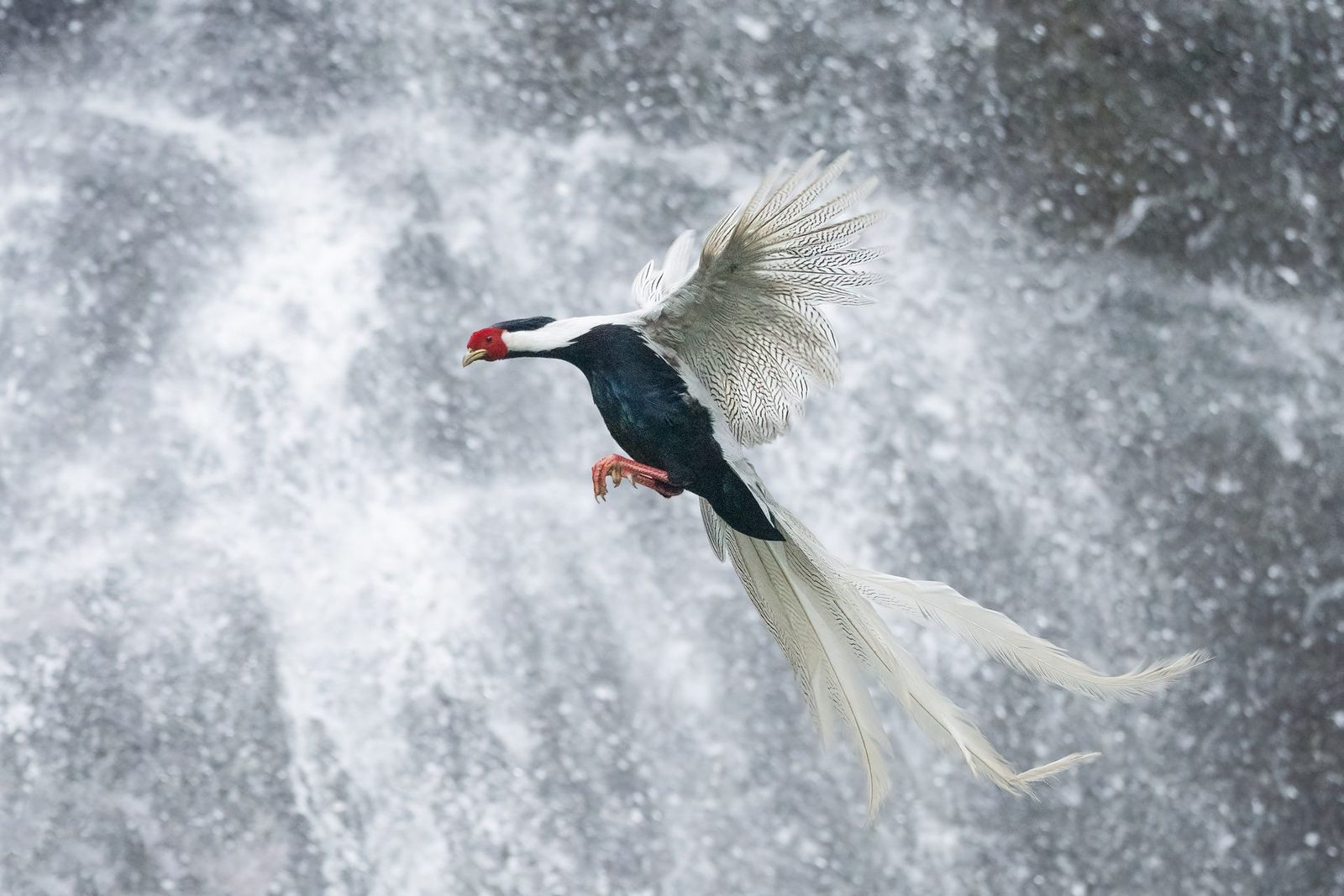
The air moving rapidly around the bird's wings produces the lift force. The bird bends its wings is thus accelerated. If it inclines its wings upward at a very steep angle, air cannot easily flow to the upper parts of the wings and the bird loses speed and stalls. Through Allah's inspiration, birds make use of the princles of aerodynamics as they fly.
Footnotes
- Uwe Schmitt, "Chaffey, N.J. ed. Wood formation in trees—cell and molecular biology techniques", Annals of Botany, 2002, cilt 90, no. 4, ss. 545-546. ↩
- Julian Vincent, "Tricks of Nature", New Scientist, 17 Ağustos 1996, cilt 151, no. 2043, s. 39. ↩
- Julian Vincent, "Tricks of Nature", New Scientist, 17 Ağustos 1996, cilt 151, no. 2043, s. 40. ↩