Surah adh-Dhariyat, 7
The Skies with ‘Woven’ Orbits
The Arabic word "alhubuki," translated as "furnished with paths" in the seventh verse of Surat adh-Dhariyat, comes from the verb "hubeke,"meaning "to weave closely, to knit, to bind together."The use of this word in the verse is…
وَٱلسَّمَآءِ ذَاتِ ٱلْحُبُكِ ٧
"By heaven furnished with paths "
The Arabic word "alhubuki," translated as "furnished with paths" in the seventh verse of Surat adh-Dhariyat, comes from the verb "hubeke,"meaning "to weave closely, to knit, to bind together."The use of this word in the verse is particularly wise and represents the current state of scientific knowledge in two aspects.
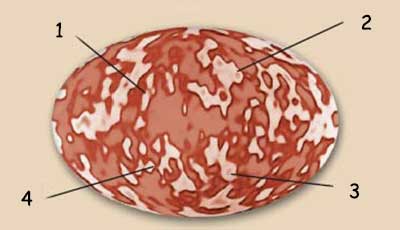
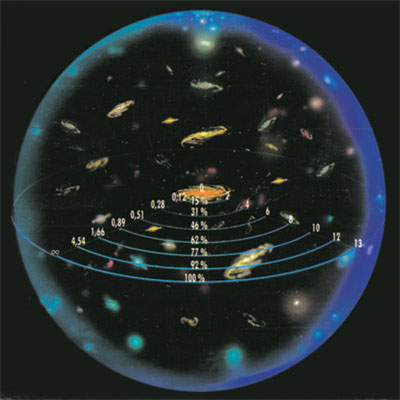
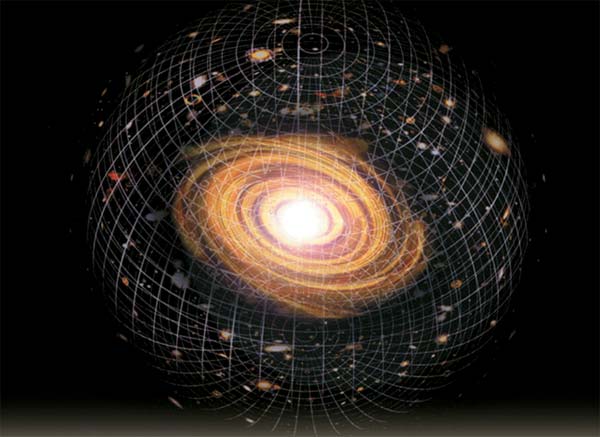
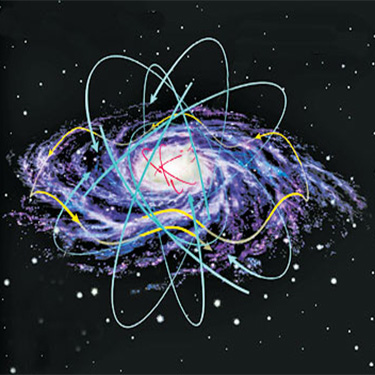
Firstly, the orbits and paths in the universe are so dense and intertwined that they constitute intersecting paths, just like the threads in a piece of fabric. The Solar System we live in is made up of the Sun, the planets and their satellites – along with heavenly objects such as meteors and comets, which are in constant motion. The Solar System moves through the galaxy known as the Milky Way, which contains 400 billion known stars.1 It is estimated that there are billions of galaxies. Miraculously, celestial bodies and systems revolve at speeds of thousands of kilometers an hour. They move through space without colliding with one another when logically, one would think they would collide with each other constantly.

The science of astronomy was developed with the aim of mapping the positions and courses of stars. Meanwhile, the study of astro-mechanics was developed in order to determine the manner in which these complex motions actually work. Astronomers used to assume that orbits were perfectly spherical. The fact is, however, that heavenly bodies are known to follow mathematical shapes, such as spherical, elliptical, parabolic or hyperbolic orbits. Dr. Carlo Rovelli of the University of Pittsburgh says, "Our space in which we live is just this enormously complicated spin network."2
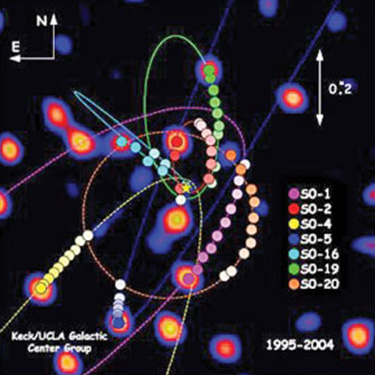
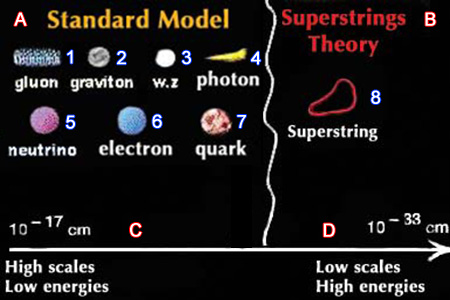
Secondly, the description of the sky in the Qur’an - using a word meaning "woven" - may be a reference to the String Theory of physics. (Allah knows the truth.) According to this theory, the basic elements that comprise the universe are not point-like particles, but strings resembling miniature violin strings. These tiny, identical and one dimensional strings oscillating in the form of filaments are rather like loops in appearance. Modern-day thinkers assume that the origin of all the diversity in the universe lies in the way these “strings” operated at different levels of vibration, in the same way that violin strings produce different sounds with different vibrations depending on how they are plucked.3
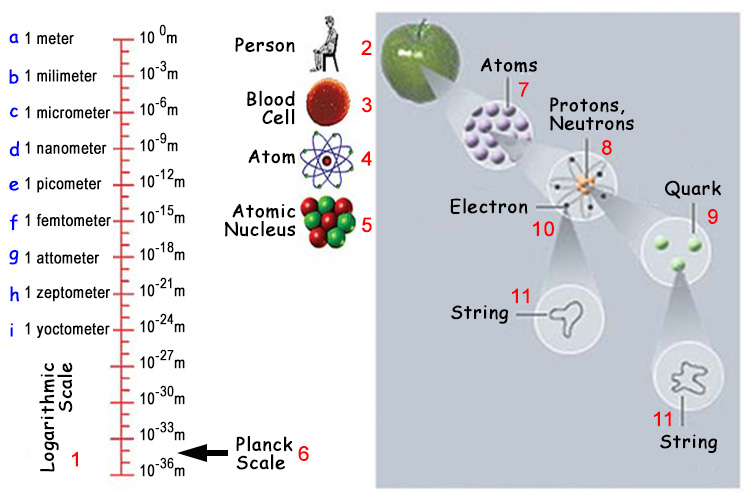
Although it is not possible to see the size of the threads in the String Theory, famous theses - such as Einstein’s theory of general relativity and his ideas on quantum mechanics – can still be calculated mathematically. These strings, which scientists regard as the material from which space and time are woven, are just 1.6x10⁻³⁵ m 0.000000000000000000000000000000000016 meters) in size.4 This, known as Planck's length, is the smallest known measurement, being just ten to twenty of the protons that make up the nucleus of that atom.5 If an atom were to be magnified to the size of the Solar System, each one of these strings would be no bigger than an average-sized tree.6 Also, we must constantly bear in mind that an atom is 100,000 times smaller than the smallest thing that can be seen with the naked eye. It is only when one remembers facts like these can a person truly grasps how extraordinary the atomic world really is.
Professor of Physics Abhay Ashtekar from the University of Pennsylvania and Professor of Physics Jerzy Lewandowski from the University of Warsaw interpret the woven appearance of space as follows in an article titled "Space and Time Beyond Einstein":
In this theory, Einstein wove the gravitational field into the very fabric of space and time... The continuum we are all used to is only an approximation. Perhaps the simplest way to visualize these ideas is to look at a piece of fabric. For all practical purposes, it represents a two-dimensional continuum; yet it is really woven by one-dimensional threads. The same is true of the fabric of space-time. It is only because the "quantum threads" which weave this fabric are tightly woven in the region of the universe we inhabit that we perceive a continuum. Upon intersection with a surface, each thread, or polymer excitation, endows it with a tiny "Plank quantum" of area of about 10-66 cm. So an area of 100 cm has about 1068 such intersections; because the number is so huge, the intersections are very closely spaced and we have the illusion of a continuum.7
An Article in the New York Times seeking an answer to the question "How Was the Universe Built?" contained the following lines:
Even the tiny quarks that make up protons, neutrons and other particles are too big to feel the bumps that may exist on the Planck scale. More recently, though, physicists have suggested that quarks and everything else are made of far tinier objects: superstrings vibrating in 10 dimensions. At the Planck level, the weave of space-time would be as apparent as when the finest Egyptian cotton is viewed under a magnifying glass, exposing the warp and woof.8
In his book Three Roads to Quantum Gravity, the theoretical quantum physicist Lee Smolin devotes one chapter to "How to Weave a String" and says this on the subject:
... Space may be'woven'from a network of loops... just like a piece of cloth is 'woven' from a network of threads.9
In his book Our Cosmic Habitatthe cosmologist and astrophysicist Prof. Martin Rees says:
According to our present concepts, empty space is anything but simple... and on an even tinier scale, it may be a seething tangle of strings.10
Allah describes the universe as being woven paths and orbits in verse 7 of Surat adh-Dhariyat – and this demonstrates that the Qur'an agrees with modern science. This perfect harmony between the Qur'an and present day scientific developments clearly reveals that the Qur'an is the word of our Lord, the Creator of all. He knows best about all things. Indeed, He asks a pertinent question in one particular verse:
أَفَلَا يَتَدَبَّرُونَ ٱلْقُرْءَانَ ۚ وَلَوْ كَانَ مِنْ عِندِ غَيْرِ ٱللَّهِ لَوَجَدُوا۟ فِيهِ ٱخْتِلَٰفًۭا كَثِيرًۭا ٨٢
"Will they not ponder the Qur'an? If it had been from other than Allah, they would have found many inconsistencies in it."
Footnotes
- Abhay Ashtekar, Jerzy Lewandowski, " Space and Time Beyond Einstein", Rzeczpospolita, Nisan 2002; http://gravity.psu.edu/people/Ashtekar/articles/Rzeczposp… ↩
- George Johnson, "How Is the Universe Built? Grain by Grain", The New York Times, 7 Aralık 1999; http://www.nytimes.com/library/national/science/120799sci… ↩
- Lee Smolin, Three Roads to Quantum Gravity, Basic Books, New York, 2001, s. 186. ↩
- Martin Rees, Our Cosmic Habitat, Princeton University Press, 2001, s. 107. ↩
- Rudiger Wehner, "Bird Navigation—Computing Orthodromes", Science, 12 Ocak 2001, cilt 291, no. 5502, ss. 264–265. ↩
- Pierre Jean Hamburger, La Puissance et la Fragilité, Flammarion Pub., Paris, 1972. ↩
- Peter Berthold, "Bird Migration: Introductory Remarks and Overall Perspective", Torgos, 1998, cilt 28, ss. 25-30; http://www.birds.org.il/show_item.asp?itemId=1211&;levelId=811&template=209 ↩
- http://www.forestpathology.org/wood.html; Wood Chemistry and Anatomy, 2005. ↩
- http://www.forestresearch.gov.uk/fr/INFD-6FMCUS; The Research Agency of the Forestry Commission, 2007. ↩
- Christophe Plomion, Gregoire Leprovost, Alexia Stokes, "Wood Formation in Trees", Plant Physiology, Aralık 2001, cilt 127, ss. 1513–1523. ↩